Sunday, March 8, 2020

Internships: How do you get one?

Hey guys! As some of you might know, I worked as a intern last summer. It was great experience and has been helpful beyond what I ever would have expected. How? Because college applications always ask for work experience and being able to say you've had an internship is a huge plus. All college admission counselors that I sent my resume to were most impressed with my interning experience. Also, it has allowed me to have my first professional job (besides interning).

So here we go:
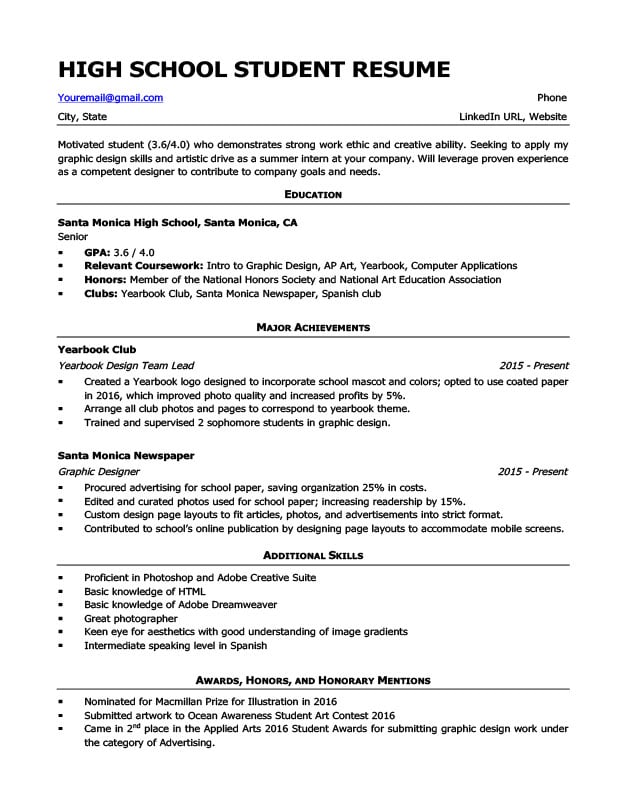
  1. Before you start looking, make a basic and PROFESSIONAL resume. Basic because you want to be able to alter it specifically to each internship you apply to without having to write a new resume for each job. You want to be able to add things not take away. Now I can't stress the need for professionalism enough. As a high school student, many employers don't expect much from you, so impress them with being professional! You will stand out!
  2. Create a LinkedIn account! Again, make it professional! Start joining groups and connection with people that are working in careers you are interested in! The Job tap obviously is very helpful to find internships especially close to you!
  3. Post in LinkedIn Groups about if anyone knows of possible internship opportunities.
  4. Find local programs that your city might have. For example: saworks.org
  5. Use google searches to find possible internship opportunities. always read the job description to make sure you are qualified and if you aren't sure try finding a contact person you can reach out to and ask.
  6. Indeed.com also lists internship opportunities. 
  7. If you still have no luck after applying to those, try reaching out to local businesses. Don't be disappointed if they don't offer any, but it's always worth a try.

The resume:
  1. Use Word templates as a guidance if you need it.
  2. It's okay if you don't have work experience yet, list leadership experience instead or community service. If you have work experience though, make it relevant to the job you are applying to! It doesn't matter if you worked in fast food and now want an internship in teaching, for example. Describe how you for example had to teach new employees company policies or things like that.  
  3. Your resume has to be somewhat memorable (not boring), but also not too creative either. Always aim for a medium. Many times employers will be understanding if it is your first job.

Promise Programs: Free Tuition at Texas Universities

Hey guys so I found this at my local library. Here is a list of Texas Universities offering free tuition bases on Family income, also called Promise Programs, and their requirements. There are but I just wanted to share these for right now!


Wednesday, January 15, 2020

Financial Aid: Subsidized vs. Unsubsidized Loans

Hey guys! So lately I've been seeing a lot of people receiving their financial aid and posting it. A lot of people seem happy about the loans but I wanted to give a quick explanation on Subsidized vs. Unsubsidized Loans because if you don't understand the difference you will have a problem with going in debt thousands of dollars more than you should or need to. 

So first of all, interest is a key part of why you have to look at your student loans VERY carefully!

Interest is defined as is payment from a borrower to a lender of an amount above repayment of the principal sum. Basically it is a percentage of the sum you borrow that you have to pay on top of the already borrowed sum of money. 

When it comes to Subsidized vs. Unsubsidized Loans this is important, since one of the key differences of the both are related to interest.

A subsidized loan does not accumulate interest while you are still in school. If you borrow $1000 the interest of $10000 won't start being added until after you graduate college. So you will start paying of the loan when it is still at $10000. A subsidized loan is generally a good loan to have if a loan is necessary. It is always better to not have any loans at all though!

On the other hand, a unsubsidized loan accumulated interest while you are in school. This mean that if you borrow $3000 as a freshman in college (the average interest rate is about 4.5%), by the time you graduate you would be paying off another $500- $1000, depending on how soon after graduation you find a good job to begin paying it off. I would not recommend getting a subsidized loan if you can do without. You can always try to at least not the first year so you have less of a build up over the 4 years. It might even be smarter to take out a bank loan since if you have a job (even if it is only part-time) you will be able to start making payments as soon as possible and won't have a build up of thousands of dollars in interest. But be careful with private loans as well! Always go for the lowest interest rate and spend time comparing which on is truly the best! Never take more money than you need!

Check out https://www.nerdwallet.com for more information and for a loan/ interest calculator!
And of course always try to get more scholarships or grants if you can to further reduce any amount you would have to take a loan out for!
Compare what school is cheapest for you! For me a school with a $33,000 tuition ended up the cheapest because of the institutional scholarships, so don't throw out schools that "cost to much" right away because you never know!

Tuesday, August 13, 2019

Reality Check before College

Hey guys! So this post is not complete college related but I do think it is extremely helpful to know about if you future career goal sustains the lifestyle you see yourself having in 10-20 years!

A couple weeks ago my amazing internship at Methodist Healthcare Ministries had a financial training day for all of their interns. At the training there were 2 wonderful Lectures telling us about how to manage our finances. On the last slide of the presentation there was a bold like saying:

Texas Reality Check

We all were told to try it and let me tell you it was very eye opening. Not only did I find out how expensive it is to have kids but also that I can be my dream career! A Biochemist! 

Now, I have to say that the reality check does factor in most expenses and income but it does forget about things such as you partners income and even insurances.
Yet is one of the most helpful tools in career planning. It even factors in where you will be living!
I really recommend taking it at least once!

Here are some reality checks I found for other states:

Monday, August 12, 2019

Associates degrees: yay or nay?

Hey guys! So this week, I actually make a very important decision in my life! I decided on starting to work on my associates degree! As many of you might have learned through my introduction post or you might know me personally, I am a high school senior as of Fall 2019. Maybe you are asking yourself how is she going to start her associates degree without even having graduated high school? 
Well you have every right to question and I am here to answer all the questions!

Let's start off with: 
What is an associates degree? ⇒ An associate degree is an undergraduate degree awarded, primarily in the United States, after a course of post-secondary study lasting two or three years. It is a level of qualification between a high school diploma or GED and a bachelor's degree. 

Where are you getting your associates? ⇒ St. Philip's College in San Antonio, Texas. 

What kind of associates are you getting? ⇒ Associates of Arts

Why are you getting an associates? ⇒ Getting an associates let's you take care of all your core requirements and other support courses/major requirements at a lower cost and can be easier if you are transitioning from high school to college. Less student debt and you have a stability at college.

How far are you into your degree?-  I have 52 credit hours done as of right now, 20 credit hours are from dual credit classes I am took/taking my senior year. So, I at the end of senior year I will definitely have 52 credit hours. In addition, I will be taking an AP test in May of 2020 depending on the results.

What do you have left to do for your associates? ⇒ For my associates I am missing a social science core and a life science core.


What are you doing right now to work towards the degree? ⇒ I am currently enrolled in 2 dual credit classes with St. Philip's College and I am studying by myself for AP tests.


Why are you doing this? ⇒ An associates can give you a great head start for Bachelors degree, especially if you want to double major for example or graduate college early. I will have all my core requirements done and even most of my elective classes. Meaning I'll have about 60 credit hours left for my degree which means I would be considered a Junior in college, right after high school! Also since I want to be in communication I would like to get some internships before I graduate 2022. Many jobs/ internships either prefer or require at least an associates degree. 

When will you finish? ⇒ I hope that I will finish the majority of my classes by Summer 2020 and will probably take 3 or 4 classes online while already enrolled at my University to finish off my degree by graduation in December.


Are you stressed/ scared? ⇒ YES! But my family is incredibly supportive and I know that even if I take a little longer I will get it done and I am excited for 2 graduations in a year! 😊
Do you have any questions? Leave them in the comments down below! ⬇

Friday, August 9, 2019

Extracurriculars that actually matter

Hey guys, so as I am finishing off most of my college applications I have noticed somethings when it comes to extracurricular activities and of course I am here to inform!

  1. Mention only activities that were actually important to you!
  2. Mention more activities that you held any leadership position in over others!
  3. Make sure you have a variety of clubs, sports, volunteering, etc.! Be well rounded!
  4. Know what your specific college is looking for!
  5. Don't make anything up!
  6. Be true about your achievements! And make sure you see everything as an achievement! For example, if you are in an environmental club and you got your school to cut plastic use by 5% that is a huge accomplishment in the eyes of admissions offices!
  7. Make sure you distinguish Activities from Honors! Honors are: National Honor Societies, winning first in a state championship, etc. Activities are: Being in book club, Volunteering at the local food bank.
  8. It is better to have a few good activities you were involved in at a regular bases, rather than have 10 activities you were semi-involved in. Some applications give you as little as 5 activities to list. The CommonApp gives you 10 activities but that does not mean you have to fill all the spots!
  9. Make sure your activities reflect who you want the college to see when they look at you! If you are passionate about gun control issues and maybe also wrote you essay about that, then why weren't you a part of your local March For Our Lives chapter?
Just some things to think about! Thank you for reading!

Thursday, August 8, 2019

Know your post-secondaries: Trade school, college, university, etc.

Hey there guys. Are you excited for school to start? Well I know a lot of you are beginning on applications and I am so excited for you guys! 

So something I have always found hard to explain to others when they ask me is: "What is the difference between a college, an university, a trade school or etc.?"

So I am here to answer the question I wish I would have had answered long ago!

Let's start by looking and some of the most common types of post secondary schools! 

  1. University
  2. 4 year College
  3. Junior College
  4. Community College
  5. Trade School
  6. Technical School
  7. Career school
  8. Vocational school
Have you hear of all these before? Any ones you hadn't heard about? 

Well let's go over them and what they mean!

Community College

→ A public two year college granting associate's degrees in two year liberal arts program and sometimes certificates in particular technical (career-related) subjects. Typically community college are open admissions. They are open to those 18 years of age or older. However, to be placed into a major, the individual must have a high school diploma, GED, or be placed according to ability to benefit. Some students start their postsecondary education at a community college and then transfer to a four-year school, either because a community college tends to be cheaper than a four-year college, or because admissions standards at community colleges are often less strenuous than at four-year schools. But mostly serve people from nearby communities and offer academic courses, technical courses, and continuing education courses. Public institutions are supported by state and local revenues

Junior College

→ In the United States, a junior college is a two-year post-secondary school whose main purpose is to provide academic, vocational and professional education. The highest certificate offered by such schools is usually an Associate degree, although junior college students may continue their education at a four-year university or college, transferring some or all of the credit earned at the junior college toward the degree requirements of the four-year school. 
The term "junior college" historically referred to all non-bachelor's degree granting post-secondary schools. However, over the last few decades, many public junior colleges, which typically aim to serve a local community, have replaced "junior" with "community" in their names. Thus, most self-identified junior colleges in the United States today are private institutions, although only a small percentage of all two-year institutions are private.

Trade School
→ A trade school, sometimes referred to as a vocational school, technical school, or vocational college, is a post-secondary institution that’s designed to give students the technical skills to prepare them for a specific occupation. Examples of trade schools include UEI, American Career College, and Chamberlain University. Trade schools can be public or private, but many are for-profit businesses.
At a trade school, you can get a degree in fields like information technology, nursing and health sciences, automotive technician training, and medical assisting. Program lengths vary, but typically, they can range from anywhere from eight months to two years.
Unlike a four-year college, you don’t graduate from a trade school with a bachelor’s degree. Usually, upon completion of the program, you'll receive a diploma or trade certificate acknowledging you successfully finished. For some programs you can earn an associate degree, which is the degree you get from a two-year college.
University
A university grants bachelor's and master's degrees, and sometimes usually include a liberal arts college, some professional schools or colleges, and graduate programs such as a law school or medical school. Universities tend to be larger than colleges, focus more on scholarly or scientific research, and might have larger class sizes. This means they can offer the two year and four-year degrees as well as graduate degrees in advanced studies beyond four years. Universities offer a huge course selection and may have extensive resources. Class size varies, depending on the size of the university, the subject area, and the course level. University professors are usually involved in research. Graduate students, rather than professors, teach some of the classes.
4-year College
A four-year college grants bachelor's degrees (Bachelor of Arts; Bachelor of Science). Some colleges also award master's degrees, and some also offer a two year Associate of Arts (AA) degree. Colleges can be specialized (for example, in nursing) or they can offer a broad curriculum, like the liberal arts which focus on the humanities, social sciences, and sciences. Classes tend to be smaller than those in universities. This provides students with more personal attention and better access to the faculty.

Wednesday, August 7, 2019

ACT and SAT test dates

Hey guys, so I know many of you probably are looking to test this year for either the ACT or SAT so here are all the test dates and registration dates. Make sure you sign up early so you do not have to pay a late fee!

2019 - 2020 ACT Test Dates and Registration

ACT Test Date
Registration Deadline
Late Registration Deadline
September 14, 2019
August 16, 2019
August 30, 2019
October 26, 2019
September 20, 2019
October 4, 2019
December 14, 2019
November 8, 2019
November 22, 2019
February 8, 2020
January 10, 2020
January 17, 2020
April 4, 2020
February 28, 2020
March 13, 2020
June 13, 2020
May 8, 2020
May 22, 2020
July 18, 2020*
June 19, 2020
June 26, 2020
2019-20 SAT Administration Dates and Deadlines
SAT Date SAT Subject Tests Available Registration Deadline Late Registration Deadline Deadline for Changes
August 24, 2019

Register

Learn more
See SAT Subject Tests available on this date July 26, 2019
August 6, 2019 (for mailed registrations)
August 13, 2019 (for registrations made online or by phone)
August 13, 2019
October 5, 2019

Register
See SAT Subject Tests available on this date September 6, 2019
September 17, 2019 (for mailed registrations)
September 24, 2019 (for registrations made online or by phone)
September 24, 2019
November 2, 2019

Register
See SAT Subject Tests available on this date October 3, 2019
October 15, 2019 (for mailed registrations)
October 22, 2019 (for registrations made online or by phone)
October 22, 2019
December 7, 2019

Register
See SAT Subject Tests available on this date November 8, 2019
November 19, 2019 (for mailed registrations)
November 26, 2019 (for registrations made online or by phone)
November 26, 2019
March 14, 2020

Register
SAT Subject Tests not offered on this date February 14, 2020
February 25, 2020 (for mailed registrations)
March 3, 2020 (for registrations made online or by phone)
March 3, 2020
May 2, 2020

Register
See SAT Subject Tests available on this date April 3, 2020
April 14, 2020 (for mailed registrations)
April 21, 2020 (for registrations made online or by phone)
April 21, 2020
June 6, 2020

Register
See SAT Subject Tests available on this date May 8, 2020
May 19, 2020 (for mailed registrations)
May 27, 2020 (for registrations made online or by phone)
May 27, 2020